
Local travel insight
A practical answer from our Tanzania team
The 7 day Machame Route Kilimanjaro is widely considered the best balance of challenge, acclimatization, and scenery for most trekkers. Often called the “Whiskey Route”, Machame is a camping trail that approaches Kilimanjaro from the southwest and descends via the Mweka Route, crossing rainforest, moorland, alpine desert and the arctic summit zone.
Around 35–50% of all Kilimanjaro climbers choose the Machame Route, making it the single most popular trail on the mountain. The recommended 7-day itinerary covers roughly 60–65 km (about 37–38 miles) from gate to gate, with a total elevation gain of about 16,000–17,000 ft. This longer schedule allows better altitude acclimatization, leading to industry summit success rates of approximately 85–90% for the 7-day Machame Route.
Difficulty is usually described as moderate to challenging: you do not need technical mountaineering skills, but you should be comfortable walking 5–7 hours per day at altitude, including one very long summit day.
7-Day Machame Route Kilimanjaro Itinerary (Gate to Gate)
Exact camp names and altitudes can vary slightly by operator, but most 7 day Machame Route Kilimanjaro itineraries follow a similar pattern.
Day 1 – Machame Gate (≈1,800 m) to Machame Camp (≈3,000 m)
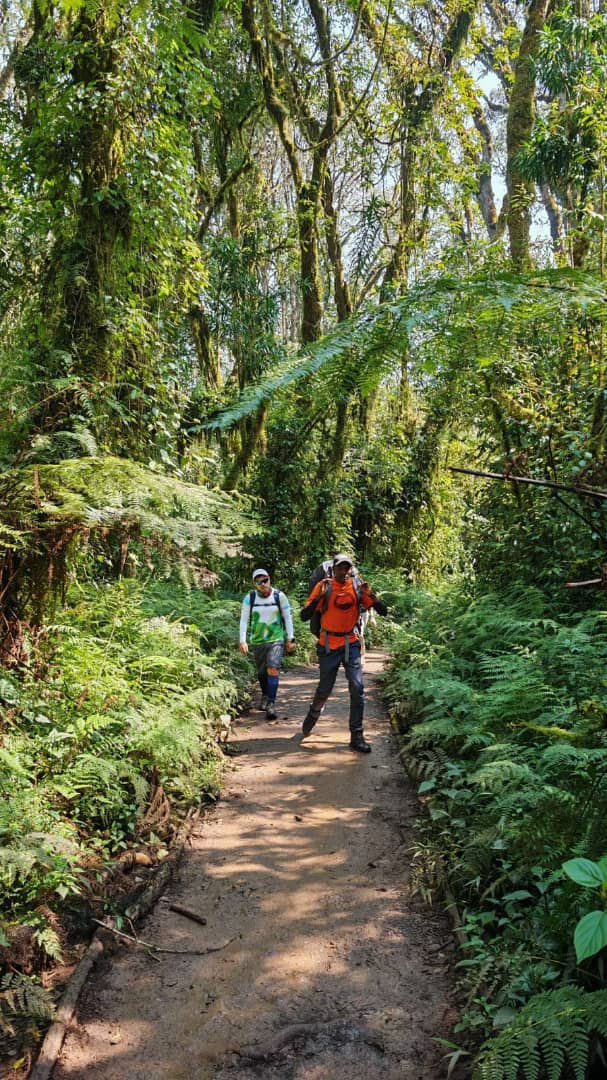
You drive from Moshi to Machame Gate, register with the park authorities, and start trekking through dense montane rainforest on well-maintained trails. Hiking time is typically 5–7 hours as you gain about 1,200 m to reach Machame Camp, where you spend your first night on the mountain.
Day 2 – Machame Camp to Shira Camp (≈3,840 m)
The landscape opens into heather and moorland, with views towards the Shira Plateau and Kibo summit. Trekkers cover roughly 7 km in 4–6 hours, steadily ascending to around 3,800–3,900 m for the night.
Day 3 – Shira Camp to Lava Tower (≈4,600 m), down to Barranco Camp (≈3,960 m)
This is the key “climb high, sleep low” acclimatization day on the 7 day Machame Route Kilimanjaro. You ascend to Lava Tower at about 4,600 m, spend time there, then descend to sleep at Barranco Camp around 3,960 m, which helps your body adapt to altitude.
Day 4 – Barranco Camp to Karanga Camp (≈4,035 m)
You tackle the famous Barranco Wall, a steep but non-technical scramble that many trekkers describe as a highlight of the Machame Route. After cresting the wall, you traverse ridges and valleys to Karanga Camp at just over 4,000 m.
Day 5 – Karanga Camp to Barafu Camp (≈4,640 m)
A shorter, steady climb brings you to Barafu Camp, the high camp for summit night. This day is focused on rest, hydration, and preparation for your overnight summit push, with camp altitudes usually between 4,600 and 4,700 m.
Day 6 – Barafu Camp to Uhuru Peak (5,895 m), descend to Mweka Camp (≈3,100 m)
Summit day on the 7 day Machame Route Kilimanjaro is long and demanding, often 10–14 hours total. You start around midnight, climb through the arctic zone to Stella Point, then continue to Uhuru Peak at 5,895 m, the highest point in Africa. After photos and celebrations, you descend back past Barafu to the lower, warmer Mweka Camp at about 3,100 m.
Day 7 – Mweka Camp to Mweka Gate (≈1,640 m), return to Moshi
The final descent through rainforest to Mweka Gate typically takes 3–4 hours. After signing out with the park and receiving your summit certificate, you transfer back to Moshi for a hot shower and celebration dinner.
Kilimanjaro Park Fees and Total Machame Route Cost in 2026
For 2026, official Kilimanjaro National Park fees for a 7-day Machame Route itinerary (including conservation fees, camping fees, rescue, crew permits and other TANAPA charges) are commonly estimated at around US$900–1,050 per person, depending on final government rates and currency. One detailed breakdown lists roughly US$910 in core park fees for a 7-day Machame camping climb.
Park fees are only part of the total cost of a 7 day Machame Route Kilimanjaro expedition. When you include guiding, mountain crew wages, tents, group equipment, meals, transfers and logistics, a mid-range, well-operated climb usually falls in the US$1,900–2,400 range, with more comfort-focused or custom climbs in the US$2,600–3,200+ range, and luxury packages at US$4,000 and above.
Ultra-budget offers below these ranges often cut corners on staff pay, equipment, safety, or acclimatization days, which can significantly affect your experience and summit chances.
Best Season for the 7 Day Machame Route Kilimanjaro
The 7 day Machame Route Kilimanjaro can be climbed year-round, but conditions are best during the two main dry seasons. The prime months are generally:
January to mid-March – Relatively dry, warm, and clear, with some chance of afternoon showers.
June to October – The main dry season, with cooler temperatures, stable weather, and excellent summit views.
The long rains (typically April–May) and short rains (around November) can bring heavier precipitation and cloud, making trails muddier and summit conditions less predictable, though crowd levels are lower.
How Hard Is the 7 Day Machame Route?
While the Machame Route is non-technical, it is not “easy.” Expect:
5–7 hours of trekking on most days, with one 10–14 hour summit push.
Altitudes up to 5,895 m at Uhuru Peak, where thin air and cold temperatures increase the challenge.
Steep sections like the Barranco Wall that require confidence on uneven terrain, but not climbing skills.
The 7-day itinerary is specifically designed to improve your chances of success, with extra acclimatization at Karanga Camp and a “climb high, sleep low” day at Lava Tower. Trekkers with basic cardiovascular fitness, prepared with several months of hiking and hill training, usually find the route demanding but very achievable with an experienced guide team.
What to Pack for a 7 Day Machame Route Kilimanjaro Climb
For comfort and safety on the Machame Route, plan to bring:
Sturdy, broken-in hiking boots and comfortable camp shoes
Thermal base layers, insulating mid-layers, and a high-quality waterproof jacket and pants
A warm down or synthetic insulated jacket for summit night
Hat, gloves (including warm summit gloves), and neck gaiter or buff
A 30–40L daypack plus a soft duffel for porter-carried gear
Sleeping bag rated to at least –10 °C, and a sleeping mat if not provided
Headlamp with spare batteries (essential for summit night)
Refillable water bottles or hydration system, and water purification tablets if desired
Personal medications, blister care, and basic first-aid items
Sunglasses, high-SPF sunscreen, and lip balm
A reputable local operator will supply communal camping equipment such as tents, cooking gear, and dining shelters, and will brief you on any additional items specific to the season.
Why Climb the Machame Route with Vilima Adventure Tours
Choosing the right local operator is just as important as choosing the 7 day Machame Route Kilimanjaro itself. A well-organized Moshi-based team ensures:
Experienced, mountain-certified guides who know the Machame trail intimately
Proper pace setting and acclimatization, which are critical for summit success and safety
Fairly treated porters, reliable camping equipment, and nutritious mountain meals
Seamless logistics from your arrival in Moshi through to your post-climb safari or Zanzibar beach extension
Vilima Adventure Tours specializes in Kilimanjaro climbs, wildlife safaris in Serengeti, Ngorongoro and Tarangire, and tailor-made Zanzibar beach holidays, making it easy to turn your Machame Route summit into a complete Tanzania adventure.
If you are ready to plan your 7 day Machame Route Kilimanjaro climb for 2026, reach out to Vilima Adventure Tours to discuss ideal dates, fitness preparation, and a custom itinerary that can combine your Kilimanjaro trek with a classic safari or time on Zanzibar’s beaches.
Around 35–50% of all Kilimanjaro climbers choose the Machame Route, making it the single most popular trail on the mountain. The recommended 7-day itinerary covers roughly 60–65 km (about 37–38 miles) from gate to gate, with a total elevation gain of about 16,000–17,000 ft. This longer schedule allows better altitude acclimatization, leading to industry summit success rates of approximately 85–90% for the 7-day Machame Route.
Difficulty is usually described as moderate to challenging: you do not need technical mountaineering skills, but you should be comfortable walking 5–7 hours per day at altitude, including one very long summit day.
7-Day Machame Route Kilimanjaro Itinerary (Gate to Gate)
Exact camp names and altitudes can vary slightly by operator, but most 7 day Machame Route Kilimanjaro itineraries follow a similar pattern.
Day 1 – Machame Gate (≈1,800 m) to Machame Camp (≈3,000 m)
You drive from Moshi to Machame Gate, register with the park authorities, and start trekking through dense montane rainforest on well-maintained trails. Hiking time is typically 5–7 hours as you gain about 1,200 m to reach Machame Camp, where you spend your first night on the mountain.
Day 2 – Machame Camp to Shira Camp (≈3,840 m)
The landscape opens into heather and moorland, with views towards the Shira Plateau and Kibo summit. Trekkers cover roughly 7 km in 4–6 hours, steadily ascending to around 3,800–3,900 m for the night.
Day 3 – Shira Camp to Lava Tower (≈4,600 m), down to Barranco Camp (≈3,960 m)
This is the key “climb high, sleep low” acclimatization day on the 7 day Machame Route Kilimanjaro. You ascend to Lava Tower at about 4,600 m, spend time there, then descend to sleep at Barranco Camp around 3,960 m, which helps your body adapt to altitude.
Day 4 – Barranco Camp to Karanga Camp (≈4,035 m)
You tackle the famous Barranco Wall, a steep but non-technical scramble that many trekkers describe as a highlight of the Machame Route. After cresting the wall, you traverse ridges and valleys to Karanga Camp at just over 4,000 m.
Day 5 – Karanga Camp to Barafu Camp (≈4,640 m)
A shorter, steady climb brings you to Barafu Camp, the high camp for summit night. This day is focused on rest, hydration, and preparation for your overnight summit push, with camp altitudes usually between 4,600 and 4,700 m.
Day 6 – Barafu Camp to Uhuru Peak (5,895 m), descend to Mweka Camp (≈3,100 m)
Summit day on the 7 day Machame Route Kilimanjaro is long and demanding, often 10–14 hours total. You start around midnight, climb through the arctic zone to Stella Point, then continue to Uhuru Peak at 5,895 m, the highest point in Africa. After photos and celebrations, you descend back past Barafu to the lower, warmer Mweka Camp at about 3,100 m.
Day 7 – Mweka Camp to Mweka Gate (≈1,640 m), return to Moshi
The final descent through rainforest to Mweka Gate typically takes 3–4 hours. After signing out with the park and receiving your summit certificate, you transfer back to Moshi for a hot shower and celebration dinner.
Kilimanjaro Park Fees and Total Machame Route Cost in 2026
For 2026, official Kilimanjaro National Park fees for a 7-day Machame Route itinerary (including conservation fees, camping fees, rescue, crew permits and other TANAPA charges) are commonly estimated at around US$900–1,050 per person, depending on final government rates and currency. One detailed breakdown lists roughly US$910 in core park fees for a 7-day Machame camping climb.
Park fees are only part of the total cost of a 7 day Machame Route Kilimanjaro expedition. When you include guiding, mountain crew wages, tents, group equipment, meals, transfers and logistics, a mid-range, well-operated climb usually falls in the US$1,900–2,400 range, with more comfort-focused or custom climbs in the US$2,600–3,200+ range, and luxury packages at US$4,000 and above.
Ultra-budget offers below these ranges often cut corners on staff pay, equipment, safety, or acclimatization days, which can significantly affect your experience and summit chances.
Best Season for the 7 Day Machame Route Kilimanjaro
The 7 day Machame Route Kilimanjaro can be climbed year-round, but conditions are best during the two main dry seasons. The prime months are generally:
January to mid-March – Relatively dry, warm, and clear, with some chance of afternoon showers.
June to October – The main dry season, with cooler temperatures, stable weather, and excellent summit views.
The long rains (typically April–May) and short rains (around November) can bring heavier precipitation and cloud, making trails muddier and summit conditions less predictable, though crowd levels are lower.
How Hard Is the 7 Day Machame Route?
While the Machame Route is non-technical, it is not “easy.” Expect:
5–7 hours of trekking on most days, with one 10–14 hour summit push.
Altitudes up to 5,895 m at Uhuru Peak, where thin air and cold temperatures increase the challenge.
Steep sections like the Barranco Wall that require confidence on uneven terrain, but not climbing skills.
The 7-day itinerary is specifically designed to improve your chances of success, with extra acclimatization at Karanga Camp and a “climb high, sleep low” day at Lava Tower. Trekkers with basic cardiovascular fitness, prepared with several months of hiking and hill training, usually find the route demanding but very achievable with an experienced guide team.
What to Pack for a 7 Day Machame Route Kilimanjaro Climb
For comfort and safety on the Machame Route, plan to bring:
Sturdy, broken-in hiking boots and comfortable camp shoes
Thermal base layers, insulating mid-layers, and a high-quality waterproof jacket and pants
A warm down or synthetic insulated jacket for summit night
Hat, gloves (including warm summit gloves), and neck gaiter or buff
A 30–40L daypack plus a soft duffel for porter-carried gear
Sleeping bag rated to at least –10 °C, and a sleeping mat if not provided
Headlamp with spare batteries (essential for summit night)
Refillable water bottles or hydration system, and water purification tablets if desired
Personal medications, blister care, and basic first-aid items
Sunglasses, high-SPF sunscreen, and lip balm
A reputable local operator will supply communal camping equipment such as tents, cooking gear, and dining shelters, and will brief you on any additional items specific to the season.
Why Climb the Machame Route with Vilima Adventure Tours
Choosing the right local operator is just as important as choosing the 7 day Machame Route Kilimanjaro itself. A well-organized Moshi-based team ensures:
Experienced, mountain-certified guides who know the Machame trail intimately
Proper pace setting and acclimatization, which are critical for summit success and safety
Fairly treated porters, reliable camping equipment, and nutritious mountain meals
Seamless logistics from your arrival in Moshi through to your post-climb safari or Zanzibar beach extension
Vilima Adventure Tours specializes in Kilimanjaro climbs, wildlife safaris in Serengeti, Ngorongoro and Tarangire, and tailor-made Zanzibar beach holidays, making it easy to turn your Machame Route summit into a complete Tanzania adventure.
If you are ready to plan your 7 day Machame Route Kilimanjaro climb for 2026, reach out to Vilima Adventure Tours to discuss ideal dates, fitness preparation, and a custom itinerary that can combine your Kilimanjaro trek with a classic safari or time on Zanzibar’s beaches.